
A Comprehensive Analysis of Repetition Compulsion, Somatic Presence, and the Energetic Path to Psychological Sovereignty
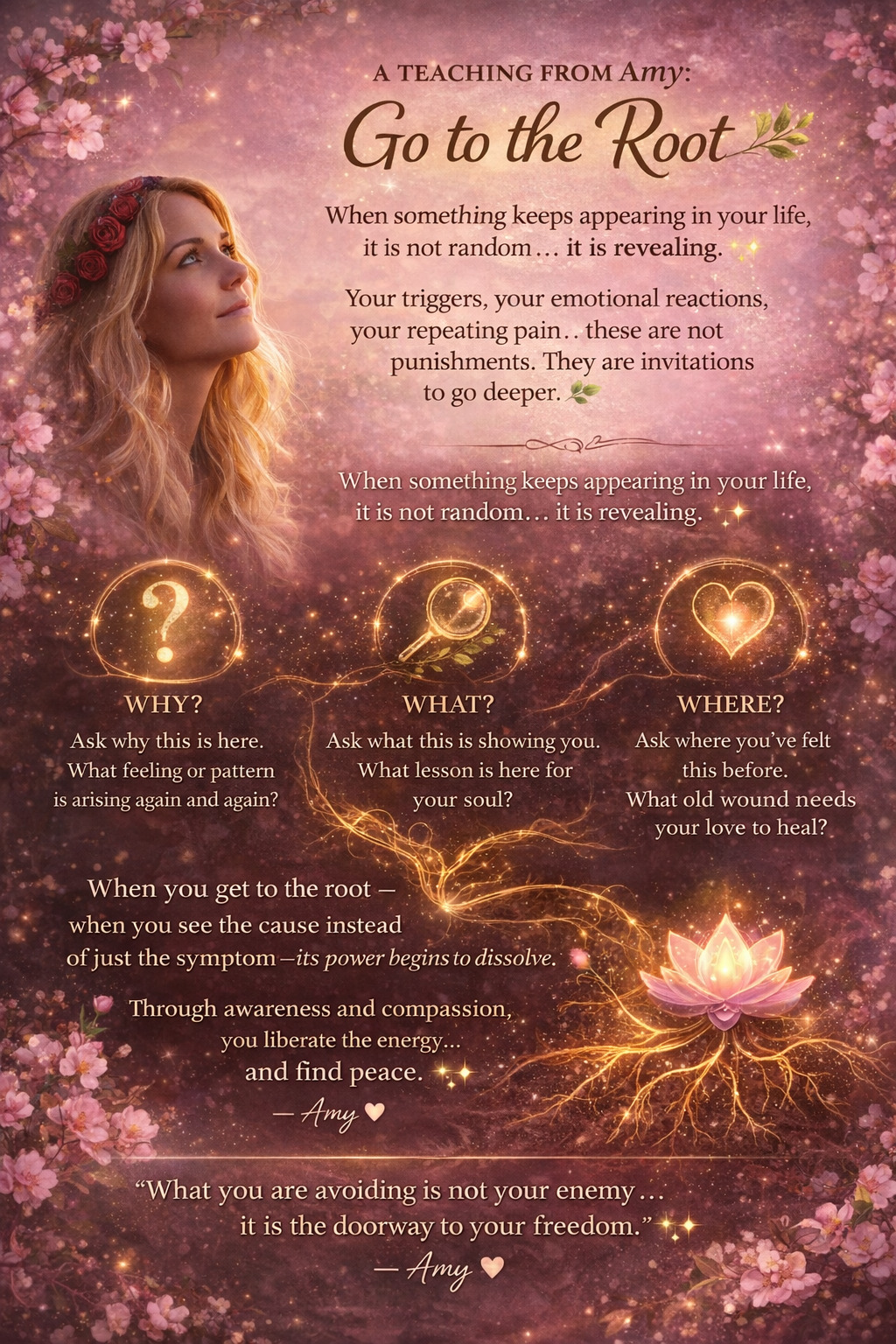
The persistent recurrence of emotional triggers and behavioral patterns is a phenomenon that has long occupied the intersection of clinical psychology, neurobiology, and transpersonal inquiry. The “Go to the Root” teaching, articulated within the collaborative therapeutic framework of Steven North and the spirit guide Amy North, posits that these repetitions are neither random nor punitive, but serve as systemic indicators pointing toward foundational psychological origins. This analysis explores the mechanisms by which the human ego maintains repetitive “loops” of pain through surface-level reactions—blame, suppression, and distraction—and contrasts this with a “root-cause” methodology involving radical honesty and somatic presence. By synthesizing the psychoanalytic foundations of repetition compulsion, the neurobiological lifespan of emotional surges, and the vibrational architecture of sound therapy, this report delineates a pathway toward what is termed “psychological sovereignty” and lasting peace.

The Ontology of Repetition: Life as a Non-Random System
The foundational premise of the Amy North teaching suggests that the appearance of persistent challenges in an individual’s life is a non-random occurrence designed to facilitate deep-seated awareness. In this view, life events are not external accidents but reflections of internal “roots” that require investigation. This ontological shift moves the individual from a “victim” state—where life happens to them—to a state of “surrender” or “sovereignty,” where life happens through or as them.
The teaching emphasizes that triggers and emotional reactions are “pointing you back to a root”. This aligns with the psychodynamic understanding that symptoms are often disguised expressions of forgotten and repressed emotional experiences. Rather than being a form of cosmic punishment, these repetitions are “showing you something,” acting as navigational markers for the soul’s evolution. The “root” represents the original point of wounding or the primary belief system formed during childhood or intergenerational trauma. Within this root, the teaching asserts, lies the individual’s “freedom”.
Comparative Framework of Life Orientations
Orientation |
Perception of Challenge |
Role of the Individual |
View of the Past |
Outcome |
|---|---|---|---|---|
Victimhood |
Random punishment/bad luck |
Passive recipient |
A source of permanent damage |
Chronic suffering/loops |
Surface Reactivity |
Annoyance to be fixed |
Defensive "soldier" |
Something to be suppressed |
Temporary relief/re-traumatization |
Root Inquiry |
Navigational indicator |
Curious observer |
A reservoir of wisdom/roots |
Transformation/Freedom |
Sovereignty |
Expression of Divine Order |
Creative vessel |
Integrated foundation |
Lasting Peace |
Table 1: Comparative Framework of Life Orientations
A comparison of how shifting from a “victim” mindset to one of “sovereignty” alters the perception of life challenges and the resulting emotional outcome
The transition from surface reactivity to root inquiry requires what is termed “radical honesty,” a willingness to look at the self without the filters of the ego. This honesty is described as a “power move” because it disrupts the ego’s primary defense strategy: the preservation of a familiar story, however painful that story may be.

The Psychoanalytic Loop: Repetition Compulsion and Internalized Objects
The “loop” described by Amy North—where individuals “feel the same pain… tell the same story… and repeat the same pattern” —is clinically recognized as repetition compulsion. Coined by Sigmund Freud, this term refers to the unconscious drive to repeat early emotional experiences, especially those that were traumatic or unresolved. The psyche, in a tragic attempt to “rewrite the ending,” places the individual in eerily similar situations, hoping that this time they can achieve mastery over the original pain.
Evidence suggests that these patterns are not merely psychological but deeply neurobiological, rooted in the earliest relational experiences. This “neurobiological pull” makes familiar pain feel safer than the unknown of a healthy dynamic. W.R.D. Fairbairn’s object relations model further clarifies that children in unnurturing environments narrow their focus and increase vigilance toward “frustrating” parental objects to ensure continued attachment. This leads to the internalization of “bad objects”—abusive or rejecting dynamics that the child “treasures” because they are reliable, even if they are harmful.
In adulthood, these internalized part-ego structures seek out external objects to re-enact the original relationship. This creates the “destiny compulsion” where individuals find themselves “dating the same type of person” or “replaying the same conflict at work”. The ego’s resistance to “going deeper” is a survival mechanism; it fears that if the loop is broken, the identity constructed around the pain will collapse.
Mechanisms of the Ego's Defensive Loop
The ego utilizes several sophisticated defenses to keep the individual “at the surface”. These defenses are unconscious strategies used to manage the anxiety arising from conflicts between instinctive demands (the Id) and moralistic standards (the Superego).
- Suppression and Repression: While suppression is a conscious decision to ignore a topic, repression is an unconscious “motivated forgetting” where unwanted thoughts are ejected from awareness. Both prevent the individual from “looking” at the root cause of their suffering.
- Blame and Projection: By attributing one’s own unacceptable traits or the cause of one’s pain to others, the individual avoids the “radical honesty” required for transformation. For instance, a student may blame a teacher for failing a test rather than acknowledging their own lack of effort.
- Distraction and Numbing: Modern avoidance strategies, such as overwork, scrolling, or substance use, serve to “push away” the presence required to sit with the emotion.
- Intellectualization: Focusing on the clinical or intellectual aspects of a problem to avoid the raw somatic experience of the emotion.
- Reaction Formation: Masking an unacceptable impulse by behaving in the exact opposite manner, such as performing “sainted” volunteer work to mask deep-seated self-loathing or anger.
Defense Mechanism |
Surface Manifestation |
Surface Manifestation |
Impact on the Loop |
|---|---|---|---|
Denial | "This isn't happening." | Protection against overwhelming reality | Freezes the trauma in time |
Projection | "They are the problem." | Preservation of self-esteem | Shifts focus away from the root |
Suppression | "I'll think about that later." | Avoidance of immediate discomfort | Stores the energy in the body |
Rationalization | "It happened for a reason." | Creating a logical facade for pain | Prevents raw emotional processing |
Displacement | Yelling at a spouse after work stress |
Discharge of tension on safe targets | Perpetuates cycles of external conflict |
Table 2: Impact of Defense Mechanisms on the Loop
An analysis of the specific unconscious strategies the ego uses to avoid the “root,” illustrating how these behaviors preserve the cycle of repetitive pain.

The Somatic Reality: Emotion as Energy in Motion
A central pillar of the Amy North teaching is the definition of emotion as “energy in motion” (e – motion). This is not merely a spiritual metaphor but a description of biological processes. Neuroscientist Dr. Candace Pert discovered that neuropeptides—the biochemical messengers of emotion—travel through the bloodstream and bind to receptors throughout the entire body, creating a seamless bridge between mind and matter.
When an individual experiences a trigger, the amygdala processes it as a threat, signaling the hypothalamus to release a chemical surge of cortisol and adrenaline. This results in physical sensations: a tight jaw for anger, chest pressure for anxiety, or heavy shoulders for sadness. The Amy teaching suggests that when we stop “grasping” onto these emotions, they dissolve. This is supported by the “90-second rule” formulated by Dr. Jill Bolte Taylor, which posits that the physiological lifespan of an emotion is only a minute and a half.
If an individual can pause and sit with the sensation without feeding it with a “story” or a “narrative,” the chemicals flush out of the blood stream and the response resolves. However, the ego often interrupts this natural flow by attaching a story (e.g., “I always fail,” “They are out to get me”), which reactivates the amygdala and creates an “emotional whirlpool” that can last for hours or years.
The Vibrational Frequency of Emotional States
| Emotion | Frequency (f in Hz) | Energetic State | Physiological Impact |
|---|---|---|---|
Shame | 20 Hz | Extreme contraction | Systemic depletion/heaviness |
Guilt | 30 Hz | Stagnation | Internalized tension/stomach knots |
Fear | 100 Hz | Agitation | Shallow breathing/jitters |
Anger | 150 Hz | Expansion/Force | Clenched fists/hot face |
Courage | 200 Hz | Neutrality/Initiation | Stabilized nervous system |
Love | 500 Hz | Coherence | Synchronized heart rhythms |
Joy | 540 Hz | Radiance | High vitality/cellular healing |
Table 3: The Vibrational Frequency of Emotional States
The biological and energetic signatures of emotional states, showing how frequency levels (f in Hz) correlate with physiological sensations and nervous system coherence.
The teaching notes that when we stop fighting the “symptom” (the physical sensation) and go to the “root” (the cause), the emotion begins to lose its hold. Transformation happens not through “force” but through “awareness” and “presence”. This requires a willingness to “sit with it” and allow the energy to move through the body’s fascia—the connective tissue shown to store emotional energy through tension and density.

The Methodology of Root Inquiry: "Why is this here?"
The Amy North teaching provides three specific questions to facilitate the journey to the root: “Why is this here?”, “What is this showing me?”, and “Where have I felt this before?”. These questions map closely to established psychotherapeutic and mindfulness protocols such as the RAIN method and Compassionate Inquiry.
The RAIN Method: A Pathway to Presence
The RAIN method (Recognize, Allow, Investigate, Nurture) is a mindfulness technique designed to manage anxiety and address negative emotions without judgment.
- Recognize: The individual pauses to acknowledge what is happening inside them, naming the emotion (e.g., “I’m feeling abandoned”).
- Allow: The individual lets the thoughts and sensations be present without trying to change or fix them. This creates the “safe container” necessary for deeper work.
- Investigate: This aligns with the “Why is this here?” question. The individual explores the emotion with “caring curiosity,” asking what the feeling is trying to communicate or what unmet need it represents.
- Nurture: Once the root is identified, the individual offers self-compassion, which allows the “frozen” trauma to begin to thaw.
Compassionate Inquiry: Drilling Down to the Core Story
Developed by Dr. Gabor Maté, Compassionate Inquiry is a process of “drilling down” to the unconscious core stories people tell themselves. This method proceeds from the understanding that “trauma is not what happens to you, but what happens inside of you” as a result of those events. By asking gentle, open-ended questions, the therapist and client unveil hidden assumptions, implicit memories, and body states that drive repeating patterns.
The question “Where have I felt this before?” is particularly potent in this framework. It bypasses the intellectual narrative and traces the current trigger to its origin—often being shamed for one’s body, punished for having a voice, or labeled as “too much” in childhood. Tracing the feeling to its root allows the individual to recognize that their current reaction is a “coping mechanism” that helped them survive in the past but is no longer necessary in the present.
| Question / Step | Amy North Teaching | RAIN Method | Compassionate Inquiry |
|---|---|---|---|
Recognition | "Pause when something arises" | Recognize | "Notice & Name" |
Acceptance | "Sit with it rather than run" | Allow | "Safe Container" |
Historical Root | "Where have I felt this before?" | Investigate (past) | "Inquiry into the past" |
Message/Purpose | "What is this showing me?" | Investigate (message) | "Unveiling assumptions" |
Transformation | "Step out of the cycle" | Nurture/Healing | "Letting go of the story" |
Table 4: Comparative Inquiry Techniques
A cross-methodology mapping that demonstrates how the questions “Why is this here?” and “Where have I felt this before?” align with established psychotherapeutic protocols like RAIN and Compassionate Inquiry.

The Energetic Bridge: Heart Activation Music and Sound Therapy
A unique component of the Steven North modality is the use of “Heart Activation Music” to support the journey to the root. This music is created in collaboration with the spirit guide Amy and incorporates encoded light frequencies, scalar energy, and binaural beats. The primary objective of this sound therapy is to bypass the conscious mind (and its associated ego defenses) to connect directly with the heart—the “nervous system of the soul”.
During the creation process, Amy is said to impart “coded vibrations” that hold messages aimed at guiding individuals toward higher consciousness. These vibrations plant “seeds of curiosity,” encouraging the listener to move from “survival mode” into states of love, peace, and clarity.
- Vibration Elevation: The music is designed to elevate the energetic frequency of the environment, purging “lingering energetic debris”.
- Crystalline Activation: The sound waves energize crystals present in the space, which act as resonators for the frequencies.
- Unconditional Love: By fostering the experience of unconditional love within the heart, the music helps dismantle the “walls of resistance” that prevent individuals from looking at the root.
Research into the “Spinal Flow Technique” suggests that concentrated attention and vibrational stimuli can restore the natural course of energy in the body, leading to profound emotional and physical healing. This aligns with the teaching that transformation happens through “awareness” and “presence”.

Radical Honesty: The Tool for Completing the Past
The Amy North teaching emphasizes that looking at the root “requires honesty,” which the ego resists. This “radical honesty” is the cornerstone of the system developed by Dr. Brad Blanton. According to Blanton, lying (including by omission) traps us in mental narratives, while honesty returns us to the present moment.
Radical honesty involves a pragmatic, functional path of sharing in detail what one feels, thinks, and has done. By “reporting” what one notices in their body and mind, the individual completes the past and frees up attention for the present. This “surrender to experience” allows things to intensify and then recede, following the natural wave of energy.
Dr. David Hawkins notes that surrendering the ego’s control through radical honesty recalibrates the individual’s “map of consciousness”. It is a practice of “unconditional surrender”—accepting all things (the “good” and the “bad”) with equal reverence, which eventually leads to life happening “through” the individual.

From Trauma to Sovereignty: The Gift in the Wound
When individuals are willing to “go to the root,” they often discover what transpersonal theorists call “The Gift in the Wound”. This concept posits that one’s deepest struggles are actually “alchemy chambers” where one’s most authentic self is forged. Rather than “getting over” a wound, the goal becomes discovering the “powerful medicine” hidden within it.This transformation is termed “Post-Traumatic Growth” (PTG). PTG refers to the positive psychological changes that occur as a result of struggling with highly challenging life circumstances. These changes include:
- Increased Personal Strength: Recognizing the “warrior within” after surviving deep pain.
- Deeper Relationships: Developing heightened empathy and authentic connections.
- Spiritual Growth: Shifting from a focus on external control to internal surrender and alignment with purpose.
- Psychological Sovereignty: Reclaiming the freedom of choice and redefining one’s identity beyond the “victim” narrative.
The process of PTG requires “deliberate engagement” with the aftermath of trauma—naming the losses, mourning what was taken, and engaging in “meaning-making”. By “holding” the trauma with presence and curiosity, the individual allows it to “speak,” eventually transmuting suffering into wisdom.

The Path to Peace: Stepping Out of the Cycle
The final stage of the Amy North teaching is the realization that “the emotion you are feeling… is not who you are”. By disidentifying from the emotional energy and returning to the “spaciousness of presence,” the individual steps out of the cycle of repetition. What once controlled them—the unconscious drivers, the internalized bad objects, the repeating triggers—no longer has power.
This state of peace is not the absence of emotion but the presence of a “loving witness” within. When pain is met with this internal witness—someone who validates and supports without blame—the wound no longer freezes into trauma. Healing begins, and “only peace remains”.
| Stage of Transformation | Characteristic Behavior | Relationship with the "Root" | Resulting State |
|---|---|---|---|
Surface Living | Reacting, Blaming, Suppressing | Avoidance / Repression | Chronic Loops / Suffering |
The Awakening | Pausing, Sitting with triggers | Initial Inquiry / Recognition | Awareness of the Cycle |
The Deep Dive | Asking "Why is this here?" | Active Investigation | Unveiling of the Core Story |
Energetic Release | Somatic presence / Sound therapy | Somatic Integration | Dissolution of the Loop |
Sovereignty | Radical Honesty / Surrender | Full Integration | Psychological Freedom |
Peace | Loving Witness / Awareness | Transcendence | Transpersonal Peace |
Table 5: The Sequential Stages of Transformation
The progression from reactive surface living to transpersonal peace, detailing the behavioral shifts and resulting states of being as one moves toward psychological sovereignty.
The integration of these psychoanalytic, neurobiological, and transpersonal insights provides a robust framework for understanding the “Go to the Root” teaching. It moves the individual from a mechanistic response to a conscious, energetic engagement with their own history. By pausing, sitting with what arises, and investigating the historical and somatic roots of their triggers, individuals can finally “step out of the cycle” and inhabit a life defined not by past wounds, but by the sovereignty of the present moment.
Works Cited
- Heart Activation Music: Healing Through Sound, Light & Scalar Energy | Steven North, accessed on April 20, 2026, https://podcasts.apple.com/dz/podcast/heart-activation-music-healing-through-sound-light/id1123003830?i=1000727697146&l=ar
- Heart Activation Music: Elevating Consciousness Through Sound and Crystal Energy, accessed on April 20, 2026, https://steven-north.medium.com/heart-activation-music-elevating-consciousness-through-sound-and-crystal-energy-e031c173ca04
- Post-Traumatic Growth Is Real and You’ve Probably Experienced It | Psychology Today, accessed on April 20, 2026, https://www.psychologytoday.com/us/blog/feeling-it/202403/post-traumatic-growth-and-youve-probably-experienced-it
- Practicing Surrender Amidst the Demands of Modern Life – Life-Long Learner -, accessed on April 20, 2026, https://life-longlearner.com/practicing-surrender-amidst-the-demands-of-modern-life/
- Repetition Compulsion in a Time of Chaos – WILA – Wright Institute Los Angeles, accessed on April 20, 2026, https://wila.org/repetition-compulsion-in-a-time-of-chaos/
- Compassionate Inquiry® | Trauma-Informed Training & Education, accessed on April 20, 2026, https://compassionateinquiry.com/
- Compassionate Self Inquiry: 4 Steps To Healing – Intensive Therapy Retreats, accessed on April 20, 2026, https://www.intensivetherapyretreat.com/compassionate-self-inquiry/
- The Core Principles of Radical Honesty – And The Scandal That Changed Radical Honesty, accessed on April 20, 2026, https://www.patrickwanis.com/the-core-principles-of-radical-honesty-and-scandal-that-changed-radical-honesty/
- Radical Honesty | PDF | Psychotherapy | Lie – Scribd, accessed on April 20, 2026, https://www.scribd.com/document/322964381/Radical-Honesty
- Have been doing The mechanism of letting go For 6.5 Years now, and here is what I Have learnt. : r/DavidHawkins – Reddit, accessed on April 20, 2026, https://www.reddit.com/r/DavidHawkins/comments/1i4qxlw/have_been_doing_the_mechanism_of_letting_go_for/
- Inner Voice of Knowing – Apple Podcasts, accessed on April 20, 2026, https://podcasts.apple.com/au/podcast/inner-voice-of-knowing/id1701409062
- Repetition Compulsion: How Trauma Influences Relationships, accessed on April 20, 2026, https://www.bostonhealthpsych.com/blog/understanding-repetition-compulsion-how-trauma-influences-relationships
- Why You Repeat Unhealthy Patterns: Understanding Repetition Compulsion in Therapy, accessed on April 20, 2026, https://lsptherapy.com/repeating-unhealthy-patterns-understanding-repetition-compulsion/
- Why You Keep Attracting the Same Person: Repetition Compulsion and Relational Trauma, accessed on April 20, 2026, https://anniewright.com/why-you-keep-attracting-the-same-person-repetition-compulsion-and-relational-tra/
- Applying Fairbairn’s Object Relations Theory to the Dynamics of the Battered Woman – Psychiatry Online, accessed on April 20, 2026, https://psychiatryonline.org/doi/pdf/10.1176/appi.psychotherapy.1999.53.1.60
- Defense mechanism | PPTX – Slideshare, accessed on April 20, 2026, https://www.slideshare.net/slideshow/defense-mechanism-62221808/62221808
- Understanding Defense Mechanisms in Psychology | ICHARS – Institute of Clinical Hypnosis and Related Sciences, accessed on April 20, 2026, https://instituteofclinicalhypnosis.com/psychotherapy-coaching/psychodynamic-approach/defense-mechanisms-in-psychology/
- Freudian Defense Mechanisms and Empirical Findings in Modern Social Psychology: Reaction Formation, Projection, Displacement, Undo, accessed on April 20, 2026, https://www.secretintelligenceservice.org/wp-content/uploads/2016/02/Freudian-defense-mechanisms.pdf
- Effective Self-Regulation Strategies from a Therapist – Lemon8, accessed on April 20, 2026, https://www.lemon8-app.com/@leiferiksonmealone/7457786503561740846?region=us
- Understanding Freud’s Defense Mechanisms | PDF | Id | Sigmund Freud – Scribd, accessed on April 20, 2026, https://www.scribd.com/document/58005600/Ego-and-Defence-Mechanism
- Ego Psychology: Anna Freud Pt. 4 – Psych Reviews, accessed on April 20, 2026, https://psychreviews.org/ego-psychology-anna-freud-pt-4/
- Emotion: Understanding Energy in Motion | by Medina Alkadir – Medium, accessed on April 20, 2026, https://medium.com/@menaep121/emotion-understanding-energy-in-motion-17df78f31ee3
- Emotions and Energy – TheHighLevelLife, accessed on April 20, 2026, https://www.thehighlevellife.com/blog/emotions-and-energy
- Everything is Energy: Understanding the Flow of Life, accessed on April 20, 2026, https://www.meaningfulmentalhealth.com/post/everything-is-energy-understanding-the-flow-of-life
- The Power of Therapeutic Rain: Improve Emotional Well-being | Bay …, accessed on April 20, 2026, https://bayareacbtcenter.com/therapeutic-rain/
- Inner Work for Divine Feminine Energy — A Practical Guide – Life Note, accessed on April 20, 2026, https://blog.mylifenote.ai/inner-work-guide-the-key-to-divine-feminine-energy/
- The Art of Emotional Regulation: 5 Steps to Master Your Feelings – Lemon8, accessed on April 20, 2026, https://www.lemon8-app.com/@glow_thrive01/7538300569715212813?region=us
- London Workshop 2026 – David Bedrick, accessed on April 20, 2026, https://www.davidbedrick.com/london-2026
- The Compassionate Inquiry® Approach, accessed on April 20, 2026, https://compassionateinquiry.com/the-approach/
- Exploring Compassionate Inquiry Therapy in Addiction Recovery, accessed on April 20, 2026, https://crestonedetoxandrehabaustin.com/therapies/compassionate-inquiry/
- Compassionate Inquiry and Philosophical Therapy – Clinical Psychotherapy and Analysis, accessed on April 20, 2026, http://www.psychoanalysis.center/issues-assisted/compassionate-inquiry-and-philosophical-therapy
- Dr. Gabor Maté on Compassionate Inquiry, with Sean Fargo – Mindfulness Exercises, accessed on April 20, 2026, https://mindfulnessexercises.com/podcast-episodes/dr-gabor-mate-on-compassionate-inquiry-with-sean-fargo/
- The Spinal Flow Technique and the Quantum Body: A Clinical Investigation into Collective Coherence and Consciousness – JCER of QuantumDream, Inc., accessed on April 20, 2026, https://www.jcer.com/index.php/jcj/article/download/1196/1174
- The Path to Spiritual Advancement: How to Transcend the Ego and Experience the Presence of God (Lectures Jan & Feb 2002 Transcription) – David Hawkins, accessed on April 20, 2026, https://veritaspub.com/product/the-path-to-spiritual-advancement-how-to-transcend-the-ego-and-experience-the-presence-of-god/
- The Gift in the Wound – IDHA-NYC, accessed on April 20, 2026, https://www.idha-nyc.org/post/2021/2/7/the-gift-in-the-wound
- The Five Domains of Post-Traumatic Growth: A Clinical Deep Dive – Annie Wright, LMFT, accessed on April 20, 2026, https://anniewright.com/five-domains-post-traumatic-growth-clinical-guide/
- Post Traumatic Growth, Lake Mary Counselor – The Self-Care Path, accessed on April 20, 2026, https://selfcarepath.com/post-traumatic-growth/
- Holding Onto Unhealed and Hidden Trauma? Look for Signs and Solutions, accessed on April 20, 2026, https://www.psychowellnesscenter.com/Blog/holding-onto-unhealed-and-hidden-trauma-look-for-signs-and-solutions/
- Post-Traumatic Growth: Resilience and Courage in PTSD Survivors – New Age Psychiatry, accessed on April 20, 2026, https://newagepsychiatry.com/post-traumatic-growth-resilience-and-courage-in-ptsd-survivors/
- Post-Traumatic Growth « – AURELIS, accessed on April 20, 2026, https://aurelis.org/blog/cognitive-insights/post-traumatic-growth
- The Neuroscience Behind Belief: Why Neville Was Right and SATs is Full Proof – Reddit, accessed on April 20, 2026, https://www.reddit.com/r/NevilleGoddard/comments/1mh0an6/the_neuroscience_behind_belief_why_neville_was/
- The Two Most Toxic Patterns In Relationships – Pattison Professional Counseling and Mediation Center, accessed on April 20, 2026, https://www.ppccfl.com/blog/the-two-most-toxic-patterns-in-relationships/


